Course information:
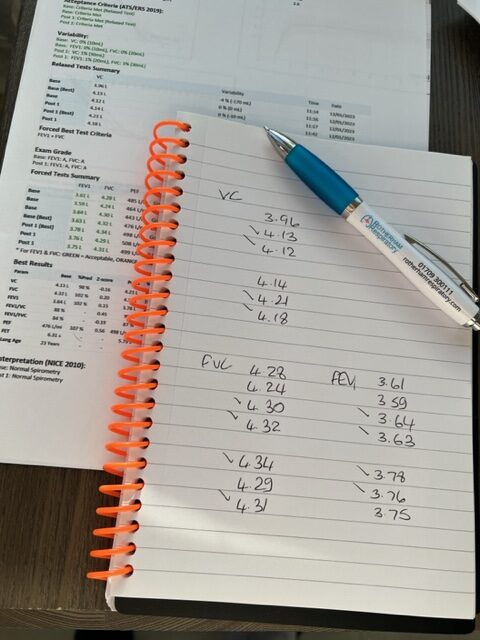
Spirometry Reporting / Interpreting – Seven Steps Course (online)
This course looks at spirometry interpretation and clearly defines the difference between numerical reporting and clinical interpretation leading to diagnosis. It is aimed at health care professional who do not perform spirometry but are required to oversee results and prepare a clinical report (ARTP website).
It can be used by those who have previously undertaken spirometry training or education and now wish to focus on the results of the test. The course will help to prepare you for the reporting only part of the ARTP register by teaching a systematic approach and using case studies to support reflective practice.
The seven-step approach to ensuring a trace is ‘fit for purpose’ and can be reported was created by our clinical expert who has also written and designed the e-learning (Chris Loveridge). She has years of experience in working clinically alongside training and education. She was part of the working party that created ‘A guide to quality assured spirometry in primary care’ (2013) and authored the 10 steps included within it.
The difference between numerical (reporting) and clinical interpretation will be explored but with a clear focus on how to report. A variety of case studies will be used (Normal, Obstructive, Reversible, Restrictive and Combined) and discussion around new guidelines and recommendations will be included.
As with all our courses there are PP video presentations for each session, with interactive knowledge checks and guided learning activities which offer further learning. The final assessment will consolidate the learning that has taken place.
Learning Outcomes
By the end of the course, the course learners will be able to:
- Critically appraise numerical spirometry against a clinical presentation and identify next steps.
- Reflect on current/past practice of spirometry reporting utilising a systematic approach.
- Consider accuracy of report writing to enable others to understand and action appropriately.
- Identify ongoing training needs to ensure early and accurate diagnosis and Identify own role in support of peers and others within workplace.
Cost per place on the course
+VAT
- 7.5 hours study time
- 1 month to complete
This course looks at spirometry interpretation and clearly defines the difference between numerical reporting and clinical interpretation leading to diagnosis.
Outline content:
Presented in 6 defined sessions of approximately 75 minutes learning and activities (per session) this course provides reflective case studies on numerical reporting with a systematic approach (Seven Steps) to underpin them.
It will cover:
- A systematic approach to spirometry reporting
- Normal or Lower Limit of Normal (LLN) and Z scores
- An obstructive picture
- Reversibility – a pragmatic approach
- Restriction – what next?
- Combined or mixed pattern
This course is suitable for:
- CPD
- Workforce development
Endorsed by ARNS
This course is available for enrolment with start dates available every week
For further details please CONTACT US